
Exit devices and panic hardware
Repair, adjustment and replacement of panic bars and exit devices — safety-critical hardware on every egress route in your building.
The one piece of hardware that cannot be allowed to fail
An exit device exists so that a person who has never been in the building, in the dark, possibly in smoke, can get out by pushing on something. There is no instruction to read and no handle to work out.
That makes a jammed panic bar different in kind from most door faults. A sticking office door is an irritation. An exit device that does not release under pressure is a life safety failure, and it is also a Fire Code violation on an egress route.
They also take more abuse than any other hardware in the building — pushed hard, used as a handle to pull the door shut, loaded with carts and freight, and in many buildings operated hundreds of times a day.
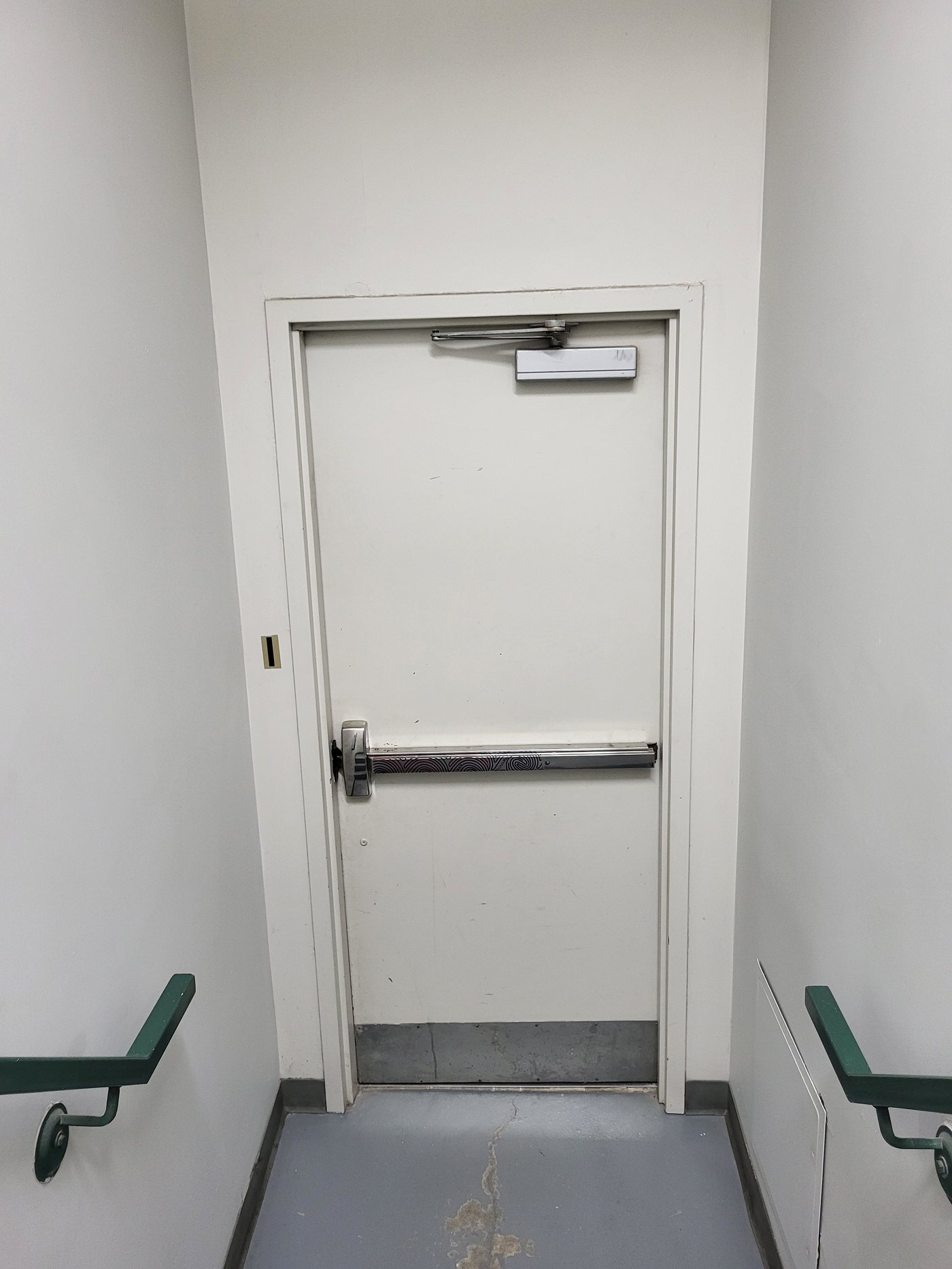
Common faults
Sticking or stiff operation
Internal wear, debris, or a mechanism that has never been serviced. Presents as a bar needing a firm shove rather than a light push.
Latch not retracting fully
The bar depresses but the latch does not clear the strike. The door then needs forcing, which is exactly what should never be necessary.
Misaligned strike
The frame has moved or the door has dropped. The device works perfectly and still will not release because it is no longer meeting the strike squarely.
Dogging failure
Dogging holds the latch retracted during business hours. When it fails, the door is either permanently latched or will not secure at all.
Bent bars and damaged end caps
Impact from carts and freight. A deformed bar may still operate but will not travel correctly across its full width.
Vertical rod problems
On pairs, concealed or surface vertical rods must retract top and bottom together. Misadjustment leaves one end engaged and the door immovable.
Some requests we have to decline
Exit hardware attracts a particular kind of request, usually well intentioned and usually about security or drafts.
- Fitting a lock, chain or bar that prevents egress
- Disabling an exit device so a door stays secure
- Permanently dogging a device that should latch
- Adding hardware requiring a key, code or special knowledge to get out
- Blocking or obstructing an egress door
If a door is being propped or secured because of a genuine operational problem, there is nearly always a compliant way to solve it — delayed egress, alarmed hardware, electrified devices that release on alarm. We would rather find that than fit something that traps people.
Egress doors have their own requirement
Section 2.7 of the Ontario Fire Code, as amended effective 1 January 2026, requires monthly inspection and annual testing of doors on means of egress, and of doors fitted with electromagnetic locking devices, with records maintained.
Mag-locked doors must release on fire alarm and on power failure. That needs verifying rather than assuming.
Exit device work we carry out
- Adjustment, servicing and lubrication of rim, mortise and vertical rod devices
- Latch and strike alignment correction
- Dogging mechanism repair and replacement
- Vertical rod adjustment on pairs, concealed and surface
- Bar, end cap and trim replacement
- Full device replacement, matched to the existing door preparation
- Alarmed and delayed egress devices
- Electrified exit hardware and electric latch retraction
- Listed replacements on fire-rated assemblies
We service devices from Von Duprin, Sargent, Detex, Corbin Russwin, Yale, dormakaba and others.
Panic bar sticking?
Do not leave it. Egress hardware is the one thing in the building that has to work first time, every time, for someone who has never used it.