Who Is Responsible for Fire Doors in a Leased Building?
In a leased commercial building, fire door inspection is the duty nobody does. The landlord assumes the tenant handles their own premises. The tenant assumes the landlord handles the building. Both point at the lease, and the openings go uninspected for years.
The Ontario Fire Code does not care what the lease says. It places the obligation on the “owner”, and it defines that word far more widely than almost anyone expects.
What the Code means by “owner”
Division A, Article 1.4.1.2 defines an owner as any person, firm or corporation having control over any portion of the building or property under consideration. It expressly includes the persons in the building.
Read that again, because the operative words are control and any portion. Not title. Not the name on the deed. Control, over any part of it.
Article 1.2.1.1 then states that, unless otherwise specified, the owner is responsible for carrying out the provisions of the Code.
So in a multi-tenant building, there is rarely one owner for Code purposes. A tenant with control of their demised premises can be an owner in respect of the doors inside them. A property manager running the common areas is an owner in respect of those. A condominium corporation is an owner. All of them at once, for different portions of the same building.
The lease allocates cost. The Code allocates responsibility.
This is the distinction that resolves most of the confusion, and it is worth stating plainly: those are two different questions and the answer to one does not settle the other.
Your lease may well say the landlord maintains building systems, or that the tenant is responsible for the interior of the demised premises. That clause governs who pays and who arranges the work. It is a contract between the two of you.
It does not change who the Fire Code holds responsible, because the Code was not a party to your lease. An inspector looking at a fire door inside a tenant’s unit is looking at a door that the tenant has control over. The lease is not a defence to an order; at most it is a route to recover the cost from the other party afterwards.
Which is exactly how buildings end up with nobody doing the work. Both parties have read a clause that makes it somebody else’s problem, and both are partly right about cost and entirely wrong about duty.
What the duty actually is
Two things, and they are separate.
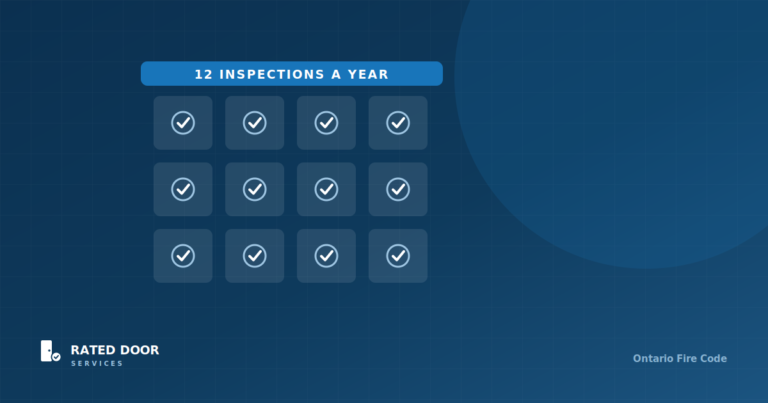
Doors in a fire separation must be inspected monthly. That is Division B, Article 2.2.3.4(4), and it is long-standing — it was not introduced by the 2026 amendments, whatever you may have been told. We wrote about what O. Reg. 87/25 actually changed, and this was not it.
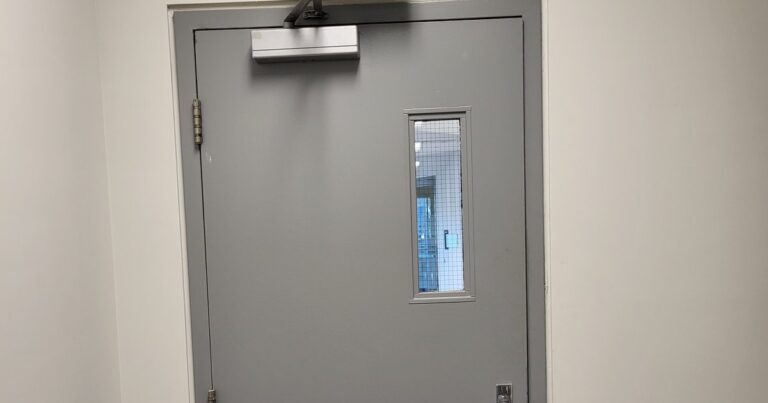
Closures must be maintained so they are operable. Which in practice means a door that closes and latches on its own, with its hardware intact and nothing holding it open.
Neither duty is onerous on a single door. Across a building with forty rated openings, done twelve times a year, with a record that would survive being asked for, it becomes a program rather than a task — and that is the point at which it stops happening by itself.
What happens if it is not done
Worth being accurate here, because there is a lot of marketing in this industry that is not.
There is no monetary penalty provision in the Fire Code for these duties. You will see claims about fines attached to fire door inspection. They do not come from the Code.
What does happen is an order, made under section 21(1) of the Fire Protection and Prevention Act, 1997. An inspector who finds a non-compliant fire door can order it remedied, with a deadline. Failure to comply with an order is the point at which this becomes serious, and it is a different thing from the inspection itself being missed.
The more immediate consequence, in our experience, is commercial rather than regulatory. An order against a building lands on whoever has control of that portion, which may be the tenant who assumed it was the landlord’s job. It arrives with a deadline, and nobody has a contractor lined up.
What to do about it
- Establish who has control of which openings, in writing, before anyone needs to know. In most buildings this takes one conversation and a floor plan.
- Read the lease for the cost allocation, and treat it as exactly that. If the clause is ambiguous, that is a question for your own legal advisor rather than for a door contractor — including us.
- Get the inspections done and the records kept regardless of who pays. The work is not expensive relative to the alternative, and an undocumented inspection is of little use when somebody asks you to produce it.
- If you are a tenant, do not assume the building’s program covers the doors inside your premises. Ask, and get the answer in writing. Frequently it does not.
- If you are a landlord or manager, the opposite: do not assume tenants are handling their own. An order against the building is your problem whatever the lease says about recovery.
The practical version
If you are reading this because you are not sure whether anybody has inspected your fire doors, the answer is almost certainly no. That is not a criticism — it is the normal state of a leased building, for exactly the reason this post describes.
The useful next step is a list: how many rated openings, where they are, and who has control of each. Everything else follows from that, including who should be paying for it.
What the Ontario Fire Code requires Fire door inspection
This post describes what the Fire Code says. It is not legal advice, and the allocation of cost under a particular lease is a question for a lawyer rather than a door contractor. Code references are to O. Reg. 213/07 as amended. NFPA 80 is a paywalled standard which we have not read; every reference to it on this site comes from a government document citing it.