The Door Closes But Will Not Latch — What’s Actually Wrong
It is the fault we find more than any other, and the one most often left alone. The door swings shut, it looks closed, and if you push it, it drifts open. Everyone in the building has learned to give it a shove, and nobody has reported it.
On an ordinary office door that is an irritation. On a fire door it is a Fire Code failure, and it means the separation that door is supposed to create does not exist.
Why latching matters more than closing
A fire creates pressure. Hot gas expands, and the difference in pressure between a burning room and the corridor beyond can be enough to push an unlatched door open — even a heavy one, even one that swung shut perfectly.
The latch is what resists that. A door held closed only by its own weight and a closer arm is not a barrier; it is a panel resting against a frame. This is why the Fire Code and NFPA 80 both require positive latching rather than simply closing — one of the criteria checked during a fire door inspection, and why “it shuts by itself” is not the same as “it passes.”
It also explains something that surprises people during an inspection: a door can look immaculate, swing beautifully, have a legible label and an intact seal, and still fail on this one point.
What actually causes it
The strike has moved
The most common cause by a distance. The latch bolt and the strike plate have to line up within a few millimetres. Buildings move, frames get knocked, hinges wear, and the alignment that was correct at installation drifts.
Usually the latch is hitting the strike plate slightly high, low, or short of the opening. Sometimes you can see the witness marks — a bright scar on the strike where the bolt has been rubbing.
The fix is normally shimming the strike, filing the opening slightly, or repositioning the plate. Twenty minutes, and it restores the door completely.
The door has dropped on its hinges
Heavy doors sag. Hinge screws work loose in the jamb, the leaf drops a few millimetres at the latch edge, and the bolt no longer meets the strike. On hollow metal and solid core wood doors this is routine wear rather than a defect.
Longer fasteners into the frame studs, hinge shims, or replacement hinges. Left long enough the door starts catching on the frame as well, which accelerates everything.
The closer has lost power
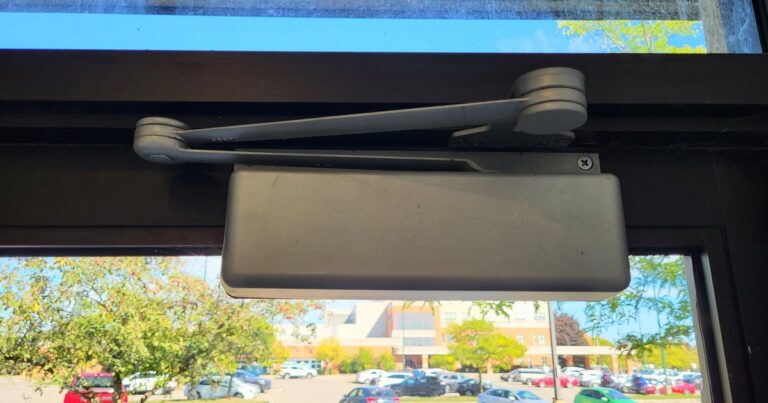
A door closer has to do two things: bring the door to the frame, and then drive the last few degrees with enough force for the latch to engage. That final stage is the latching speed adjustment, and it is the first thing people turn down when a door is slamming.
Turn it down too far and the door arrives at the frame without enough momentum to latch. The door appears to work; it simply stops short. A closer that has lost hydraulic pressure internally produces the same result and cannot be adjusted back.
The latch bolt itself is worn
Thousands of cycles wear the bolt and its spring. A bolt that no longer extends fully, or that retracts too easily under pressure, will not hold. Usually obvious once you look at it beside a new one.
Air pressure is fighting the door
This one gets missed. Stairwell pressurisation systems, HVAC imbalance, and the stack effect in a tall building all create pressure differentials across doors. A door that latches fine on a mild day can fail in winter, when a heated building is pushing hard against cold outside air.
If a door latches sometimes and not others, and nothing about the hardware has changed, the building is usually the cause rather than the door.
Something is in the way
Carpet that has lifted, a threshold that has risen, a door sweep fitted too low, or gasketing added during a refit that now holds the door a few millimetres off the stop. Each is enough to prevent the bolt reaching the strike.
What not to do about it
There are three common fixes we are asked for, and all three make things worse.
Do not pack out the strike aggressively. Shimming a strike to meet a dropped door treats the symptom. The door is still dropping, and the gap at the hinge edge is still growing — which on a rated door is its own deficiency.
Do not remove the closer. On a fire door the self-closing device is part of the certified assembly. A door that latches when pushed but does not close by itself has traded one code failure for another.
Do not fit a magnetic catch or a ball catch to hold it shut. It is not a listed component, it does not provide positive latching, and on a rated assembly it invalidates the certification.
How to check your own doors
You do not need tools for a first pass. Walk the building and, at each door:
- Open it about halfway and let go. Do not help it.
- Watch whether it closes fully, without stopping short.
- When it reaches the frame, listen for the latch. You should hear it engage.
- Then push the door, firmly, from the closed position. It should not move.
That last step is the one people skip, and it is the one that matters. A door can sound like it has latched and still be held by nothing more than friction.
If a door fails that test and it is fire rated, it is a deficiency and it should be recorded and corrected. If it is not rated, it is still worth fixing — a door that does not latch is a security gap, a noise problem, and a complaint waiting to arrive.
The good news
Of all the deficiencies we find during commercial door repair work, this is among the cheapest to correct. Strike alignment, hinge fasteners and closer adjustment cover the large majority of cases, and none of them require a new door or new hardware.
It is also the one most likely to have been sitting unreported for years, because the building has quietly adapted around it. Which means a walk-through usually finds several at once — and fixing them is a short job rather than a project.
This article is general information, not legal advice. Your local fire prevention officer is the authority on what applies to your building.
Doors in your building not latching?
Most are a twenty-minute fix. We will walk the building, test every opening and tell you which are code failures and which are simply annoying.