
Sliding and pocket doors
Tracks, rollers, guides and hardware for doors that slide rather than swing — including the pocket doors nobody can get at.
A sliding door is a piece of machinery
A swing door hangs on hinges and gravity does most of the work. A sliding door is carried on rollers running in a track, and every one of its problems traces back to that: the rollers wear, the track moves, the guides break, and the whole assembly falls out of alignment.
That makes them a different repair discipline. Replacing hinges on a swing door is straightforward. Diagnosing why a sliding door binds halfway along its travel means understanding whether the fault is the carrier, the track, the guide, the door itself, or the wall the track is fixed to.
It also means they are frequently written off as unfixable by trades who do not work on them regularly. Most are entirely repairable.
Sliding door types
Bypass and sliding doors
Two or more panels sliding past each other on parallel tracks. Storage, closets, service areas and meeting room dividers.
Pocket doors
Sliding into a cavity inside the wall. Space-efficient and excellent when working — and the hardware is behind drywall when it is not.
Barn-style sliders
Surface-mounted track above the opening, panel hanging below on exposed rollers. Increasingly common in modern office fit-outs.
Telescoping doors
Multiple panels that stack as they open, used where a wide opening has limited wall space beside it.
Folding and accordion partitions
Multi-panel room dividers on overhead tracks. A lot of moving parts and a lot of ways to jam.
Sliding glass and office fronts
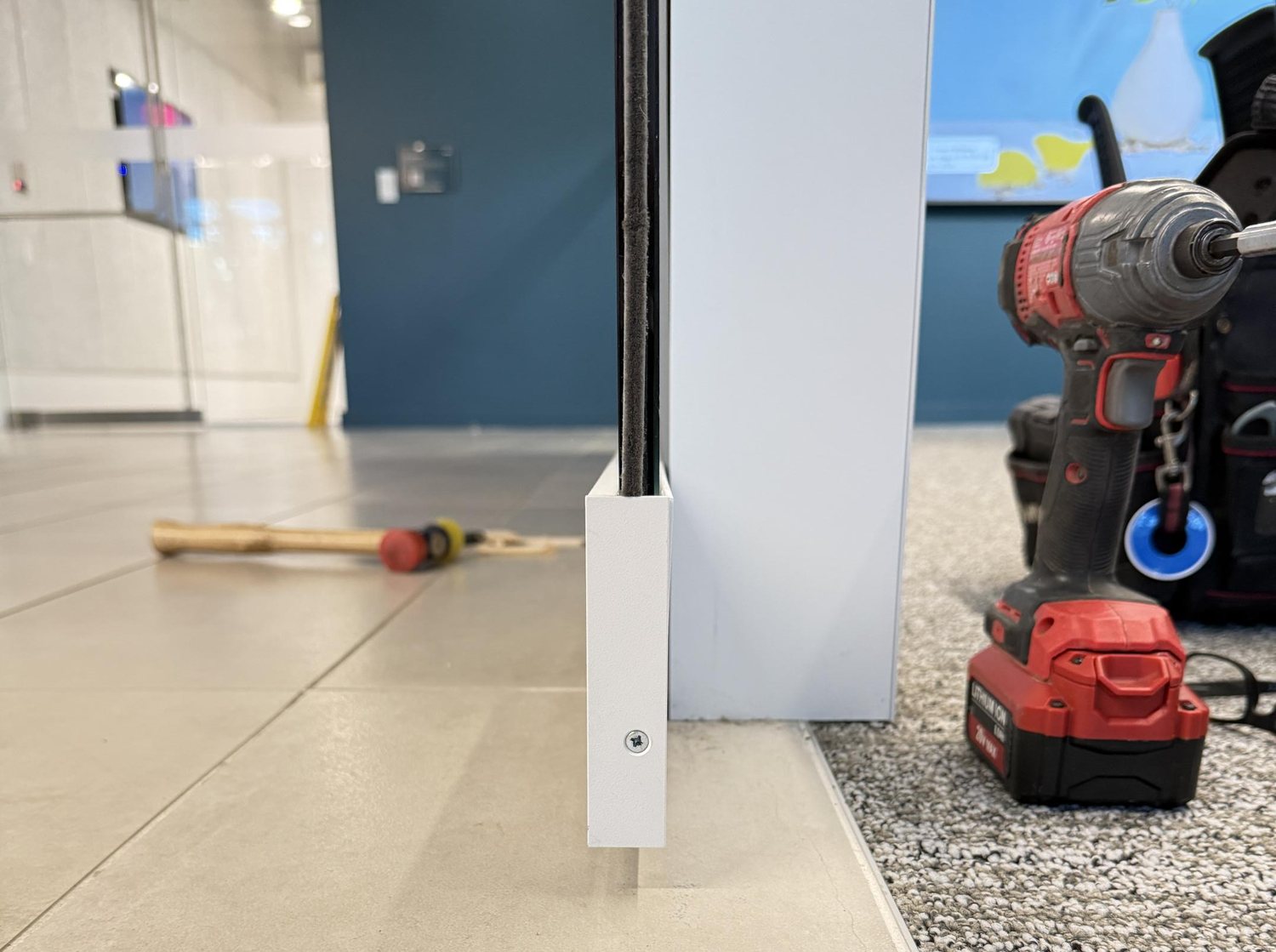
Framed or frameless glass panels on top-hung hardware, common in meeting rooms and reception areas.
The faults we see most
The door binds or needs forcing
Usually worn rollers or debris in the track. Carriers have bearings, bearings wear, and once a roller develops a flat spot it drags rather than rolls. Cleaning the track fixes a surprising number of these; the rest need new carriers.
The door has come off its track
Almost always follows the door being forced while already binding. The panel jumps the track, which can bend the track and damage the carrier on the way. Re-hanging is straightforward; the underlying cause needs fixing or it recurs.
The door swings or rattles at the bottom
The floor guide has broken, worn or come loose. On a top-hung door the guide is the only thing controlling the bottom edge, and without it the panel swings into the frame each time it moves.
The track has dropped or pulled away
Sliding panels are heavy and the fixings carry that weight continuously. Track fixed into drywall without proper backing will eventually pull out. This is the fault most often mistaken for a broken door.
A pocket door will not move at all
The hardware is inside the wall, so diagnosis is the work. Usually a failed carrier or a track that has dropped at one end. Some can be reached through the opening; others need a section of wall opened. We will tell you which before starting rather than after.
Soft-close and stops have failed
Dampers, buffers and end stops take the impact of a heavy panel repeatedly. When they fail the door slams into the jamb, which damages both.
Movable walls and folding partitions
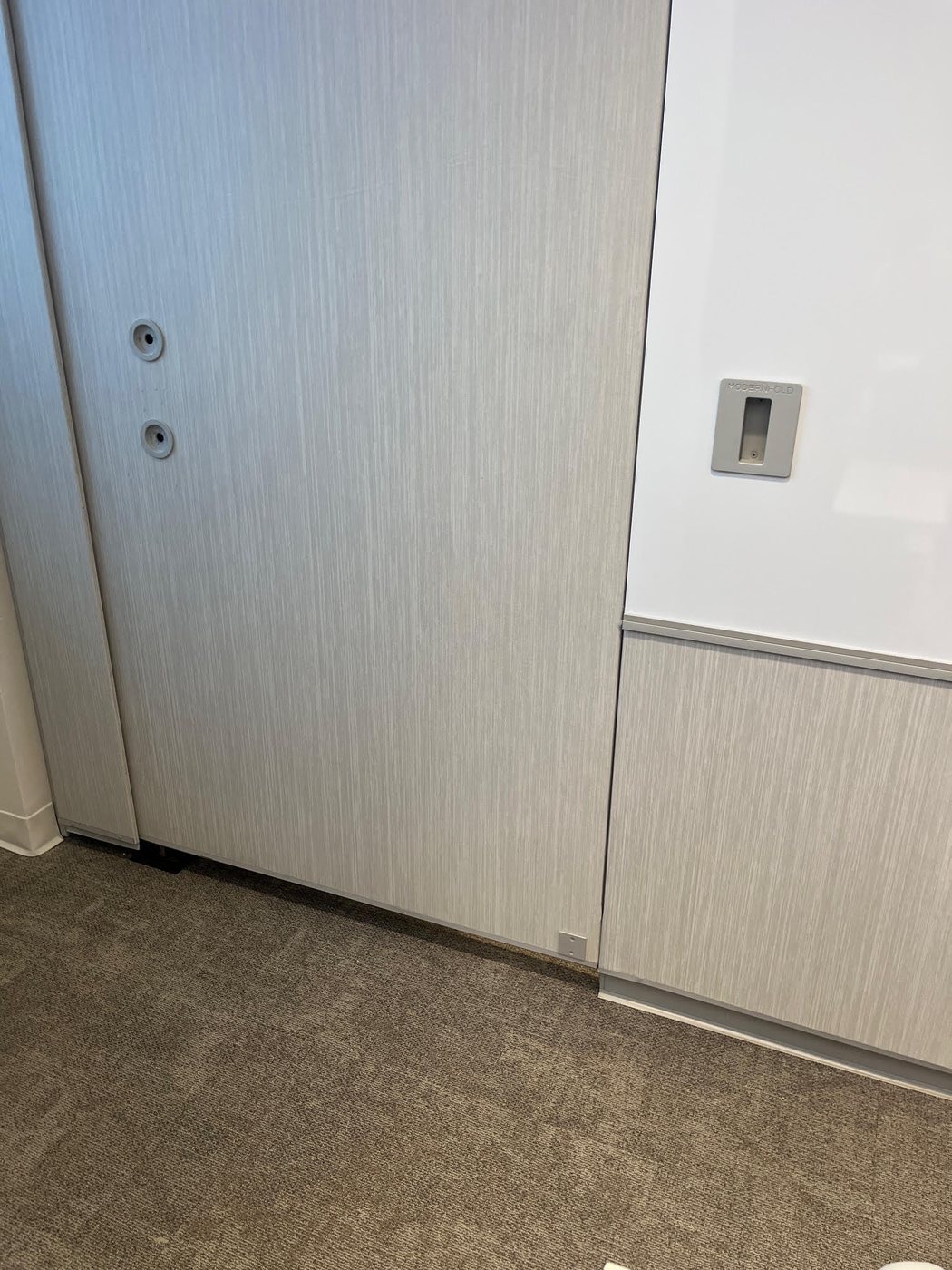
Operable partition systems — the movable walls used to divide conference rooms, training rooms and function space — are the most hardware-intensive doors in any building.
Each panel hangs from carriers in an overhead track, with seals top and bottom, interlocking edges, and pull hardware on every leaf. A system with twelve panels has twelve of everything, and one seized carrier stops the whole wall.
They are also frequently left unserviced for years, because nothing is obviously broken until the day the room needs dividing and the panels will not track.
Some sliding doors are fire doors
Horizontal sliding fire doors exist, and they are not ordinary sliding doors.
Held open, released on alarm
Horizontal sliding fire doors exist — rated assemblies held open and released on alarm, common in industrial buildings and between rated areas.
They look like ordinary sliding doors and they are not. The release mechanism has to work, the door has to close fully, and the assembly has to be documented like any other rated opening.
If your building has one, it carries the same monthly inspection obligation as any other door in a fire separation.
Why pocket doors get replaced when they could be repaired
A pocket door that has stopped working is often declared beyond economic repair, and a swing door is fitted instead. Sometimes that is the right answer. Frequently it is not.
The reason it happens is access. The track and carriers sit inside the wall cavity, so a trade unfamiliar with the hardware cannot see the fault and reasonably concludes the whole thing needs replacing. But many pocket door systems are designed for serviceability — some allow the panel to be lifted out through the opening, and some have removable track sections.
Where wall access genuinely is needed, it is usually a limited section above the opening rather than the whole wall, and it is patchable.
We will look before quoting, and we will tell you plainly when replacement is the better answer.
Sliding door work we carry out
Diagnosis and repair
- Roller and carrier replacement
- Track cleaning, realignment and replacement
- Floor and bottom guide replacement
- Re-hanging doors that have come off track
- Track re-fixing with proper structural backing
- Pocket door diagnosis, including access where required
Hardware and control
- Soft-close dampers and buffers
- End stops and travel limits
- Flush pulls, edge pulls and privacy latches
- Barn-style track hardware and anti-jump devices
- Folding partition hardware and hinges
- Accessible pull hardware and opening force adjustment
Sliding door questions
Can a pocket door be fixed without opening the wall?
Our sliding door keeps coming off the track. Why does it keep happening?
Is it worth repairing or should we replace?
Do you work on folding partitions and room dividers?
Can you install new sliding or barn-style doors?
Our sliding fire door has not been tested. Can you help?
Tell us about the door
A photograph of the door and the track is usually enough for us to tell you what is involved and roughly what it will cost.
For pocket doors, a photograph of the opening and any visible hardware helps — we can often narrow the likely fault before attending.
Monday to Friday, 8am–5pm. After-hours by arrangement.
Request service
We reply within one business day.