
Door closers
Repair, adjustment and replacement of commercial door closers — the single most common fault in any building, and the one most often lived with.
What your closer is telling you
A closer is a hydraulic device doing the same job thousands of times a year. It does not fail suddenly — it drifts, until someone notices the door is not shutting properly.
The door closes but stops short of latching
Latching speed turned down too far, or the closer has lost power through internal wear. On a fire door this is a Fire Code deficiency, not an inconvenience — a door that does not latch is not a fire separation.
The door slams
Closing speed set too fast, or a failed hydraulic valve no longer regulating flow. Beyond the noise, repeated impact damages the frame, the hinges and eventually the door.
The door is hard to push open
Spring tension too high or the closer binding internally. Worth knowing that opening force is an accessibility requirement as well as a comfort one.
Oil on the door or the floor beneath
Seals have failed and the closer is losing hydraulic fluid. There is no repair for this. It will lose control of the door entirely, usually at an inconvenient moment.
The door bounces off the frame
The latch is not catching, so the door rebounds. Either latching speed, a misaligned strike, or a worn latch bolt.
The door swings wide and hits the wall
Backcheck has failed or was never set. Without it the door takes the wall, and the hinges take the strain.
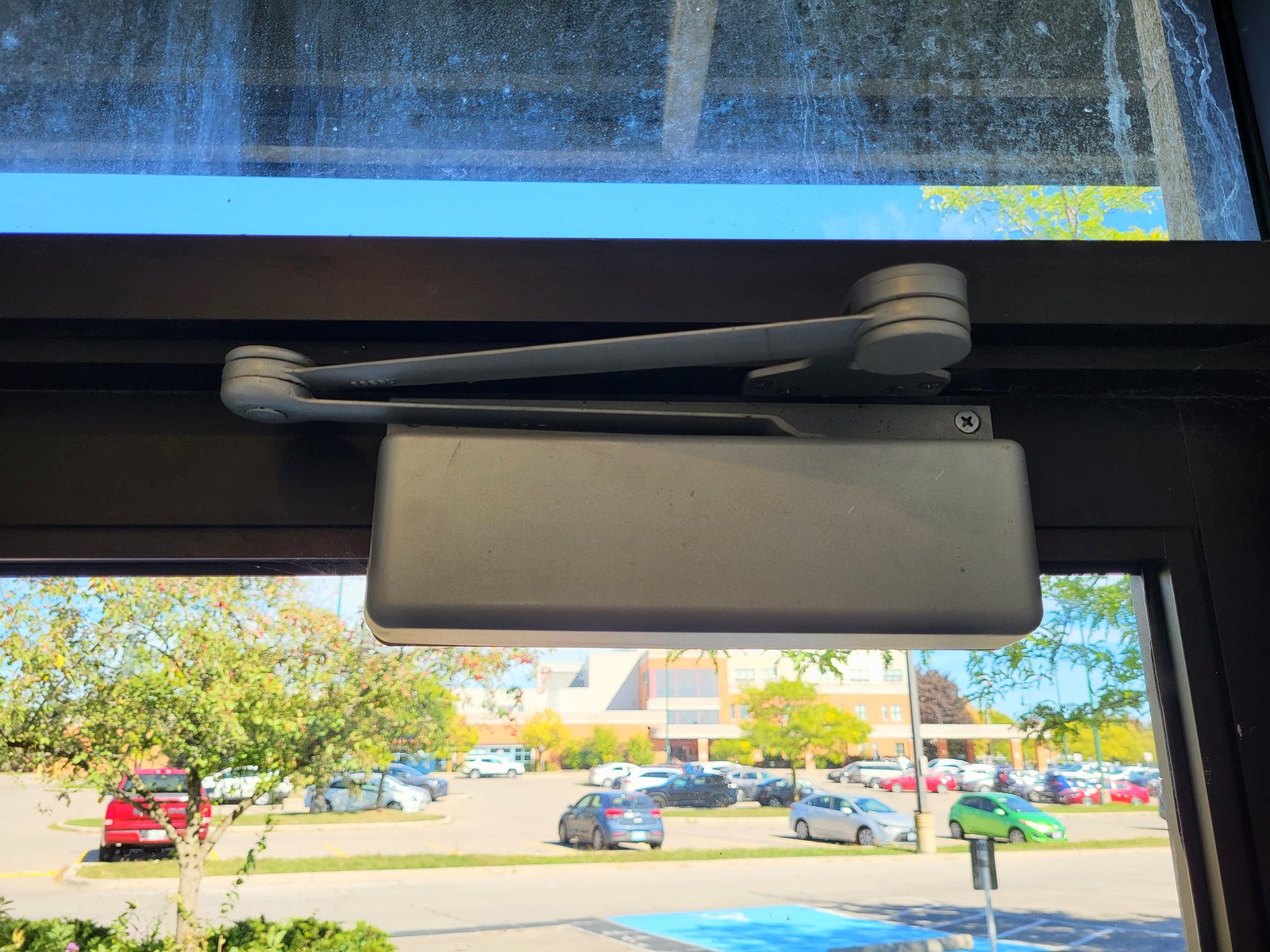
What can be fixed and what cannot
Most surface closers have three or four adjustment valves — closing speed, latching speed, backcheck and sometimes delayed action. A competent adjustment takes fifteen minutes and resolves a large share of complaints.
What cannot be adjusted: failed seals, worn internal valves, a cracked body, a bent arm. Those need replacement.
A caution worth passing on. Closer valves are not infinitely adjustable, and backing one fully out can let the piston drive it out under pressure, emptying the closer onto the floor. This is a common outcome when someone unfamiliar decides to speed it up a bit.
Why closers fail early
The door is used as a doorstop. Forcing it past its designed arc bends the arm and damages the mechanism. Fit an overhead stop.
Wrong size specified. Closers are sized for door width and weight. An undersized closer on a heavy exterior door will never close it reliably.
Nobody has looked at it in ten years. Closers are maintenance items. An annual check extends their life considerably.
Ontario winters. Hydraulic fluid thickens in cold. Exterior closers need seasonal attention.
The closer is part of the certified assembly
On a fire-rated door the self-closing device is not an accessory. The door must return from any open position to fully closed and latched, under its own power, without assistance.
That means a closer fault on a fire door is a code deficiency. It also means the fix has to be a working closer — not removing it, not wedging the door, and not packing out the strike so the latch catches more easily.
And the replacement has to be listed for that assembly. A closer substituted for something not listed invalidates the rating on a door that works perfectly.
Closer work we carry out
- Adjustment of closing speed, latching speed, backcheck and delayed action
- Surface, overhead concealed and floor closer replacement
- Arm and bracket replacement, including parallel and regular arm conversions
- Correct sizing for door width, weight and exposure
- Overhead stops to protect closers from over-opening
- Hold-open and electrified hold-open devices that release on alarm
- Seasonal adjustment on exterior doors
- Listed replacements on fire-rated assemblies
We service closers from LCN, Norton, dormakaba, Sargent, Corbin Russwin, Hager and others. Matching a replacement to the existing preparation usually avoids re-drilling the door.
More on closers and latching
Two of the most common faults in any commercial building.
Why your door closer stopped closing properly
Read the symptom and you can usually tell whether it is a fifteen-minute adjustment or a replacement.
Read the article →The door closes but will not latch
The most common fault in any building, and on a fire door a code failure rather than an irritation.
Read the article →Door not closing properly?
Send a photograph of the closer and the door. We can usually tell you whether it is a fifteen-minute adjustment or a replacement before we attend.