
Hollow metal doors and frames
Repair, replacement and inspection of steel doors and frames — the most common commercial door in the GTHA, and the one that takes the most abuse.
Steel doors, steel frames, and a lot of misunderstanding
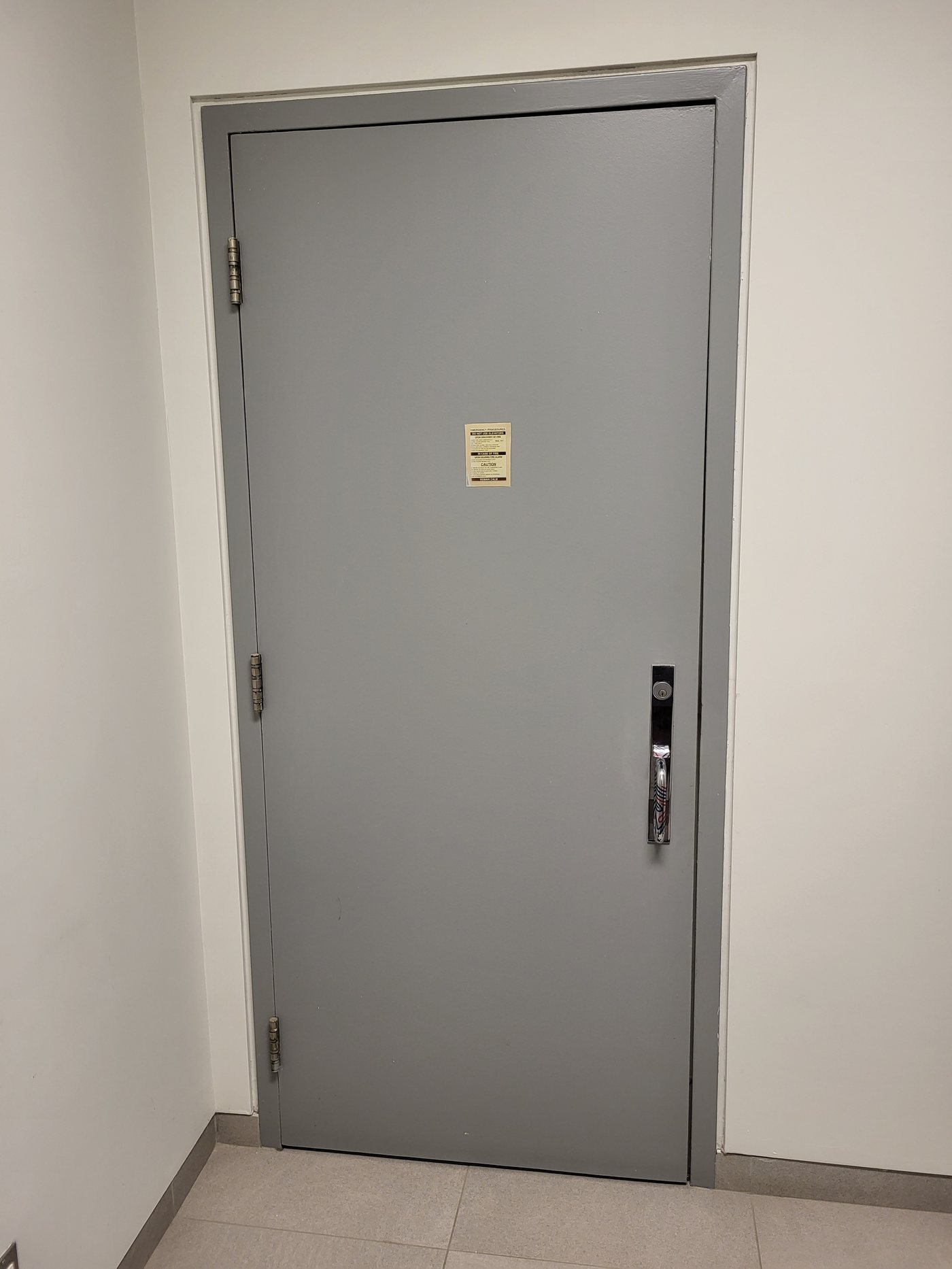
Hollow metal is the default commercial door: a steel leaf over an internal core, hung in a steel frame. Despite the name they are not empty — the core may be honeycomb, polystyrene, mineral board or steel stiffened, and what is inside determines whether the door is fire-rated and for how long.
You will find them on stairwells, mechanical and electrical rooms, service corridors, exterior entries, loading areas and between tenancies. In most buildings they are the majority of the openings, and a large proportion are fire-rated whether or not anyone on site is aware of it.
The common faults
The door has dropped
Hinge wear lets the leaf sag, which means it catches on the frame and no longer latches. Caught early it is a shim or a hinge; left alone it damages the frame.
Frame knocked out of true
Impact from carts, pallet trucks and freight pushes frames out of square. The door then binds or fails to latch even though nothing is wrong with the leaf.
Corrosion at the base
Exterior doors and frames rust from the bottom up, particularly where salt and meltwater collect over an Ontario winter. Frames often fail before leaves do.
Field modifications
Holes drilled for hardware since removed, cut-outs for a lock that got changed, fasteners through the leaf. On a rated door anything beyond what the listing allows puts the rating in question.
Painted-over labels
A repaint with no masking makes every label in a corridor unreadable in an afternoon. Without a legible label a rated assembly cannot be verified.
Dented and deformed leaves
Impact damage that changes the door profile affects how it seats in the frame — and therefore the clearances a rated door depends on.
Most hollow metal is worth repairing
Steel is forgiving. Frames can be straightened, hinges replaced, strikes realigned, and surface corrosion treated and made good. The leaf itself is rarely the problem.
Replacement genuinely makes sense when a leaf is corroded through, a frame is pulling away from the wall or badly deformed, or a rated assembly has been modified beyond what can be reversed. That last one is the most common reason we recommend replacing a door that still works.
Where a label is missing rather than damaged, replacement is not always the only route. Field labelling through a certification organization is sometimes possible at a fraction of the cost of a new rated assembly — worth establishing before anyone quotes you a door.
Check the label before you change the hardware
A rated door is only rated because a certification organization tested that assembly and listed it. The Ontario Fire Code defines “listed” as equipment or materials included in a list published by a certification organization accredited by the Standards Council of Canada (Division A, Article 1.4.1.2).
Doors listed against Canadian standards carry the mark of the organization that listed them, and doors listed against US standards carry US marks. The two sets are not automatically interchangeable, and substituting hardware across them can put a rating in question on a door that works perfectly.
Read the label first. It is an easy mistake and an expensive one.
Hollow metal work we carry out
- Door and frame repair, straightening and realignment
- Hinge replacement, shimming and correcting sag
- Strike alignment and latching correction
- Hardware replacement — closers, exit devices, locksets, coordinators
- Gasketing, smoke seals, sweeps and thresholds
- Corrosion treatment and making good
- Full leaf and frame replacement, including rated assemblies
- Fire door inspection and documentation — the Ontario Fire Code sets the duty, NFPA 80 supplies the inspection criteria
Send us a photograph
We can usually tell you whether a hollow metal door is rated, what is wrong with it, and roughly what it will cost — before anyone attends.