Why your door closer stopped closing properly
A door closer is a hydraulic device doing the same job thousands of times a year. It does not fail suddenly — it drifts, gradually, until someone notices the door is not shutting properly. By then it has usually been failing for months.
Here is how to read what your closer is telling you. For the hardware itself, see our door closers page.
The symptoms, and what they mean
The door closes but stops short of latching
The most common complaint and the most consequential on a fire door. Usually the latching speed — the final few degrees of travel — has been turned down too far, or the closer has lost power through internal wear. Sometimes the strike has shifted and the door is actually closing fine but not engaging.
Often adjustable. If the closer has lost enough power that it cannot overcome normal air pressure in the corridor, it is at end of life.
The door slams
Closing speed set too fast, or the hydraulic valve has failed and is no longer regulating flow. On a fire door a slamming leaf is not just a noise problem — repeated impact damages the frame, the hinges and eventually the door itself.
The door is very hard to push open
Spring tension set too high, or the closer is binding internally. Worth knowing: opening force is an accessibility requirement as well as a comfort one. A door that takes real effort to open may be failing accessibility standards at the same time.
Oil on the door or floor beneath the closer
Internal seals have failed and the closer is losing hydraulic fluid. There is no repair for this. A leaking closer is replacing itself on its own schedule and will lose control of the door entirely, usually at an inconvenient moment.
The door bounces off the frame and comes back open
The latch is not catching, so the door rebounds. Either a latching speed problem, a misaligned strike, or a latch bolt that has worn.
The door swings wide and hits the wall
Backcheck has failed or was never set. Backcheck is the resistance near the end of the opening arc that stops the door being flung open. When it fails, the door takes the wall and the hinges with it.
What can be adjusted, and what cannot
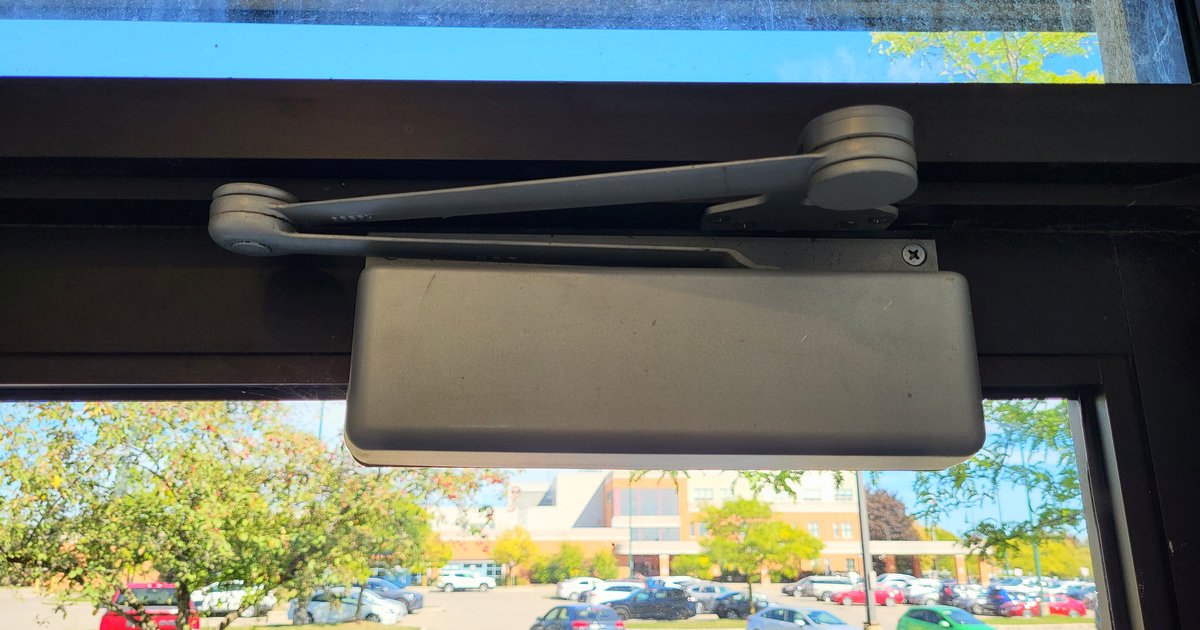
Most surface closers have three or four adjustment valves: closing speed, latching speed, backcheck and sometimes delayed action. A competent adjustment takes fifteen minutes and resolves a large share of complaints.
What cannot be adjusted: failed seals, worn internal valves, a cracked body, a bent arm. These need replacement.
A word of caution about adjustment. Closer valves are not infinitely adjustable, and turning one fully out can allow the piston to drive the valve out under pressure, which empties the closer onto the floor. This is a common outcome when someone unfamiliar with the device decides to “just speed it up a bit.”
Why closers fail early
The door is being used as a doorstop. Forcing a door past its designed opening arc — or propping it wide against a wall — bends the arm and damages the internal mechanism. Fit an overhead stop.
The wrong size was specified. Closers are sized for door width and weight. An undersized closer on a heavy exterior door will never close it reliably and will wear out fast trying.
Nobody has looked at it in ten years. Closers are maintenance items. An annual check and adjustment extends their life considerably and costs a fraction of replacement.
It is on an exterior door in Ontario. Hydraulic fluid thickens in cold weather. A closer that works fine in July may barely close the door in February. Temperature-stable fluid and correct seasonal adjustment matter here more than in milder climates.
Fire doors: why this is not optional
On a fire-rated door the self-closing device is part of the certified assembly, and it is one of the points checked during a fire door inspection. The door must return to the fully closed and latched position from any open position, under its own power, without assistance.
That means a closer problem on a fire door is a Fire Code deficiency, not a maintenance annoyance. And it means the fix has to be a working closer — not removing it, not propping the door, and not packing out the strike so the latch catches more easily.
If a door with a closer problem is fire rated, it should be treated as urgent. Ontario now requires monthly inspection of doors in fire separations, so it will be found — the only question is whether you find it or an inspector does.
Repair or replace?
This is ordinary commercial door repair work. Adjust if the door works but behaves badly. Replace if there is fluid leaking, if the body or arm is damaged, or if adjustment no longer holds for more than a few weeks.
Replacement is not expensive relative to the consequences. A closer is a modest part; a fire door that does not close is a compliance failure, and a slamming door slowly destroys a frame that costs considerably more to put right.
Closers from LCN, Norton, dormakaba, Sargent, Hager and Corbin Russwin are all common in Ontario commercial buildings, and all are serviceable. Matching a replacement to the existing preparation usually avoids re-drilling the door.
Door not closing properly?
Send us a photograph of the closer and the door. We can usually tell you whether it is an adjustment or a replacement before we attend.